
Imagine a world where treatments for illness or injury are customized not just to the disease but to the individual. Where we cure cancer by killing cancer cells before symptoms even appear. Where microscopic robots deliver drugs to the precise location where they can do the most good. And where we no longer have to worry about Alzheimer’s disease and other age-related diseases because we have trained the body to fight them.

Precision Engineering
A New Frontier for Health
Winter 2024
Sound like the stuff of science fiction? It’s not.
The groundwork for this new world is being laid right now in Penn’s Center for Precision Engineering for Health. Established in 2021, the Center brings engineering solutions to understanding, detecting, and treating disease. “It’s an investment in technology for improving human health,” explains Daniel A. Hammer, the inaugural Director of the Center and the Alfred G. and Meta A. Ennis Professor in Penn Engineering’s Departments of Bioengineering and Chemical and Biomolecular Engineering.
The Center’s work is possible thanks to discoveries made in the past few decades, including the mapping of the human genome. Scientists have been learning more about which genes cause disease, how they work together, and how we can manipulate them to produce better outcomes. Other important advances have led to a better understanding of the immune system and the interplay between the immune system and conditions such as cardiovascular disease.
Taking advantage of the extraordinary potential of such discoveries is possible only through an interdisciplinary approach that brings engineering and medical science together.
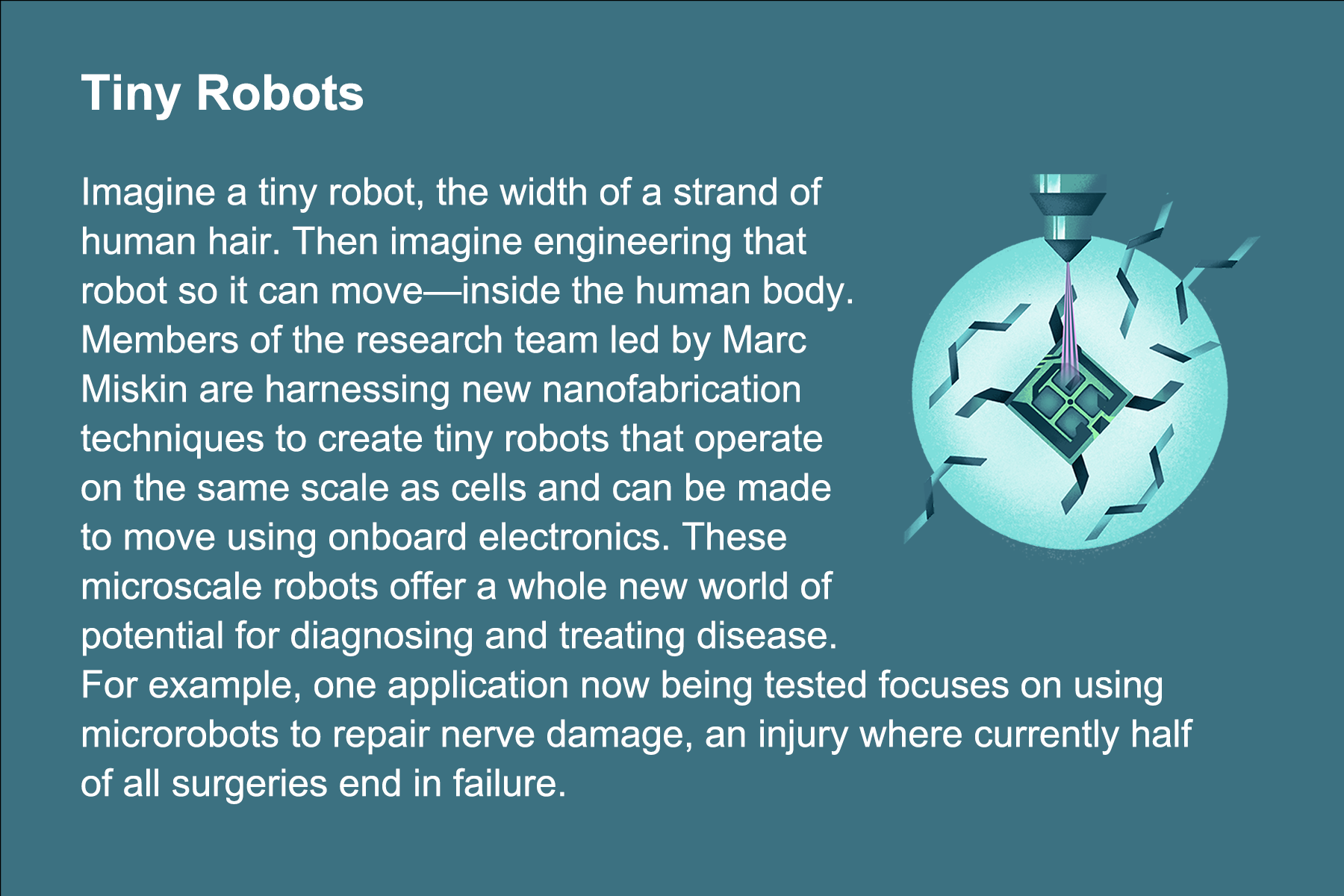
For example, engineers are uniquely well qualified to find ways to carry agents such as drugs to targeted locations in the body with great precision. They also can develop devices, some as small as a human cell, that can work inside the human body, revolutionizing treatment and diagnosis. “Engineering plays a central role in making these technologies work and maximizing their impact,” continues Hammer.
Among the nation’s universities, Penn is especially well positioned to take advantage of this emerging opportunity. The School of Engineering and Applied Science is just minutes away from the Perelman School of Medicine, and the infrastructure and culture are already in place to build on existing strengths and collaborations. Another plus: Penn has an established track record in turning discoveries in the lab into practical applications.
Penn’s unique strength lies in the perfect blend of essential elements: exceptional faculty, an esteemed medical school, a world-class health system, and a top-tier engineering school. It’s the seamless alignment of these components that sets us apart. Everything is aligned.”David F. Meaney, Solomon R. Pollack Professor of Bioengineering and Senior Associate Dean, Penn Engineering
The Center is moving forward on three fronts, explains David F. Meaney, Solomon R. Pollack Professor of Bioengineering and Senior Associate Dean of Penn Engineering. The first is recruiting talented faculty members who work at the convergence of engineering and medicine. Penn Engineering has already hired five new professors for this initiative and hopes to add at least five more.
The second thrust, which is critical in recruiting, is providing these faculty with the space to do their work. But what is needed is not just any space—it’s a different kind of space, one that fosters interdisciplinary work.
In June 2024, Center faculty will move into new labs at One uCity Square, at 37th and Filbert Streets, part of a corridor that is becoming known as the Avenue of Technology. To encourage synergy and collaboration, the One uCity building will include investigators not just from Penn Engineering but also from Penn Medicine, together with private companies working in this same sector.
The third necessary ingredient is seed funding for high-risk, high-reward projects with the potential to improve human health. Most funders, including key government agencies, provide little support for early-stage work of the kind now being done at the Center. Investigators need seed money that will allow them to test out their ideas and secure the preliminary results necessary to compete for additional support from the National Institutes of Health, National Science Foundation, and other major funders.
An entrepreneurial mindset is at the heart of the Center’s work. “If you do the fundamental science the right way, you lay the groundwork for an application that is unforeseen, and you have the perfect combination of technologies to solve your problems,” says Hammer. “The nature of basic science is that you don’t know where your discovery will go, but long-term, our goal is to have an impact on human health.”


Moving the Center Forward
To realize the transformative potential of these new technologies, the Center needs support in three critical areas: people, space, and ideas. Penn Engineering seeks funding to attract and hire the most talented faculty, provide them with lab space that fosters creativity and collaboration with partners in Penn Medicine, and offer seed money to pursue breakthrough ideas.
To learn more, contact Ellie Davis, Vice Dean of Development and Alumni Relations, Penn Engineering, at ebdavis@seas.upenn.edu or (215) 898-6564.


