“As to diseases, make a habit of two things—to help, or at least to do no harm,” Hippocrates famously wrote. Today, medicine might add the lesser-known line that preceded it: “Declare the past, diagnose the present, foretell the future.”

Early Drug Discovery Meets AI
Philanthropy is jump-starting new applications of AI across Penn Medicine
Winter 2026
At Penn Medicine, foretelling the future comes with the territory.
As industry investment pursues private interests, Penn Medicine is providing a critical, parallel path for AI that is motivated by the public good. One of the world’s leading academic medical centers, it is championing advancements in everything from drug discovery to patient care, by design: “We’ve already thought long and hard about where Penn will have the greatest impact,” says Jonathan Epstein, MD, Dean of the Perelman School of Medicine. “Early drug discovery, computer vision, and patient-provider interactions are three areas where we already have a wealth of expertise, data, and capacity. They’re also areas that the pharmaceutical industry isn’t as well positioned to address. Philanthropy will be crucial as we forge these new paths.”
On at least one path, the rubber is already meeting the road, thanks to the Stephen J. Heyman Fund for AI Innovation, which is propelling the exploration of how AI can improve early drug discovery.
Interdisciplinary research is crucial to advancing knowledge, and AI is an accelerant in that process. Penn Medicine is already known for breakthroughs, and with this work, we’ll be shaking up the world—for the better.”
Stephen J. Heyman, W’59
Impact on the Ground Floor: AI in Early Drug Discovery
On paper, early drug discovery is a deceptively straightforward process. Researchers identify and validate a biological target, test a drug against it, measure the reaction between the two, and presto! the beginnings of a pharmaceutical breakthrough.
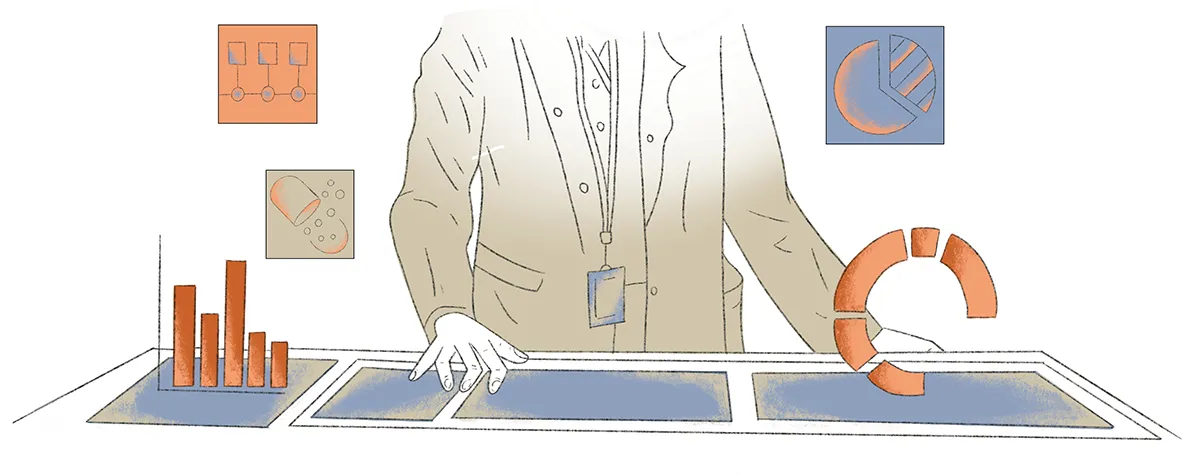
But—as in so many other areas of medical research—it’s not that simple. The process takes time, repetition, and revision. Few people understand this better than Sara Cherry, Scientific Director of the High-Throughput Institute for Discovery (HIT-ID) at Penn Medicine. “In a nutshell, high-throughput screening uses advanced robotics and specialized equipment to rapidly test thousands of biological samples,” she says. “It’s efficient, but it isn’t necessarily adapted to, say, working toward a cure for rare diseases.”
That’s why HIT-ID has partnered with Penn Medicine’s Institute for Biomedical Informatics to launch the AI Biomedical Research Accelerator, supported by the Stephen J. Heyman Fund for AI Innovation. The goal is not just to make early drug discovery more efficient, but to explore research that was previously too costly, complicated, or outright impossible without the use of AI.
“There are many people thinking about early drug discovery and others thinking about artificial intelligence, but they don’t necessarily interact,” notes Cherry. “One of the founding goals of the High-Throughput Institute was to bring ‘wet bench’ and ‘dry bench’ experts together and to leverage their combined knowledge. Being part of the AI Biomedical Research Accelerator extends that goal even further.”
Meet the Pilot Projects
TEAM 1
 The first team is pursuing new treatment options for Duchenne Muscular Dystrophy (DMD), a rare genetic mutation that destroys the body’s supply of the protein dystrophin and leads to fatal muscle loss in patients. As part of the AI Accelerator program, three Penn researchers are exploring whether another naturally occurring protein, utrophin, could serve a similar purpose. With promising preliminary results, they’re now using AI to help identify molecular designs that could increase utrophin expression.
It’s the first step in development of a new therapy for DMD, one that could change the lives of more than 15,000 young Americans currently living with the disease.
TEAM 2
The second team is applying AI to the challenge of addiction treatment, using computer models to design new peptide therapeutics that could one day improve recovery outcomes. Peptide therapeutics are notoriously difficult to design, and to be successful, the researchers are leveraging a custom AI platform to navigate an ocean of delicate variables.
The goal? A powerful new AI tool that can accurately generate new drug designs in mere minutes.
A Real Shot at Important Discoveries
 These two teams, selected from a pool of 21 applications, represent just the beginning of how Penn Medicine is using cutting-edge AI to advance early drug design research. In the words of Sara Cherry, “I think this approach of ‘model first, then test, then incorporate those findings back into the algorithm’ is the type of approach where grants like the Heyman Fund will have a big impact. A year and $100,000 is enough to give these teams a real shot at making important discoveries that will allow them to get more funding, start companies, and make a real difference.”
As Penn Medicine raises funds for additional AI acceleration grants, that spirit of anticipation is palpable. Future pilot projects could reach beyond early drug discovery to include ambient intelligence, new approaches to population health, personalized health apps, and a wide range of research partnerships. In Jonathan Epstein’s words, “The possibilities are profound.”
If we do this right, AI will have a systemic, positive impact on health care. Stephen Heyman shares that belief, and we are deeply grateful for his visionary support. Through philanthropic partnerships, Penn will have the opportunity to explore possibilities that few would have ever thought possible. We couldn’t be more excited to be driving that progress.”
Jonathan Epstein, MD
Dean, Perelman School of Medicine
Watch the inaugural Penn Medicine AI Symposium, funded by the Stephen J. Heyman Fund for AI Innovation.
To learn more about supporting this type of work, contact Paul Mischler, Chief Philanthropy Officer, at mischler@upenn.edu.