
Dialogue is a powerful thing. It forges connections between people, builds bridges across difference, and lays the foundation for understanding.

Bridging Divides
The SNF Paideia Program teaches students how to participate in civil discourse and become engaged citizens
Winter 2024
But connecting with each other in the public sphere has become more difficult—particularly on college campuses around the country, which have dealt with incidents of antisemitism, Islamophobia, and other forms of hate. Daily civic discourse is becoming less effective, partisan divides are growing wider, and the idea of compromise is getting further and further away.
As people struggle to communicate, cultivating effective contexts where those with different views can thoughtfully engage with each other is more important than ever. The Stavros Niarchos Foundation (SNF) Paideia Program is teaching students how to engage in productive dialogue despite differences in ideology, background, or experience.
Sydney Nixon, C’23, recently graduated from Penn with a degree in political communication and was part of the first cohort of SNF Paideia Fellows. The focus of her academic study was civic and political dialogue, but she explains that SNF Paideia provided more than just knowledge—it taught her a way to productively converse with people who have different political and ideological viewpoints.
Rather than just teaching students about discourse, the Program taught them how to participate in and gain value from effective, civil discourse. “SNF Paideia was one of the few spaces that focused on politics as conversations in our daily lives,” she says.
The Program was established in 2019 through a $6 million grant from the Stavros Niarchos Foundation (SNF). It draws its name from the ancient Greek idea of paideia, which translates to “education of the whole person” and “educating citizens,” and strives to embody a 21st-century version of those ideals.
One of the most valuable skills we can learn as young people is how to engage productively across divides. The culture of civic engagement and civil discourse blossoming in the Penn community makes a strong case for optimism in the future of our democracy and civil societies at large.”Andreas Dracopoulos, W’86, Co-President of the Stavros Niarchos Foundation (SNF)
The initial five-year program began with events, activities, and 12 interdisciplinary courses taught by Penn faculty members. The pilot program also included a small cohort of SNF Paideia Fellows who took a special series of classes and participated in a capstone project.
After three years, SNF increased its support, and SNF Paideia aimed to expand its class of fellows to 25 each year and reach 1,000 students annually through its course offerings. Today, the Program has reached those goals, and in response to the student and faculty demand for programming, SNF has recently committed to a $13 million grant that will extend SNF Paideia for another five years.
Faculty director Sigal Ben-Porath sees the benefits of SNF Paideia in her academic research on dialogue and discourse in higher education. She’s found that young people are not always invited to share their opinions, experiences, identities, and other things they care about. But that sharing is vital to education.
“The inability to listen to each other and share our views is part of what’s ailing our democratic society,” says Ben-Porath. “We need that ability to live in a self-governing society.
“Paideia is a hub for democratic opportunity, and more important than ever in times of conflict,” she adds. “The opportunities it creates infuse the campus.”
For Sydney Nixon, the techniques she learned about dialogue across difference were useful throughout her entire academic career.
In other classes, the goal was often to be right. But I learned in my Paideia courses that you should always be having a dialogue—not just a debate. Using what I learned, I had more fruitful conversations in all of my classes and a fuller academic experience.”Sydney Nixon, C’23
She even found that what she learned about dialogue helped her in her summer employment at McKinsey & Company. While those conversations weren’t inherently political, communicating across differences helped her better navigate her workplace and have productive dialogues with her new colleagues.
Michael Delli Carpini, Oscar H. Gandy Emeritus Professor of Communication & Democracy at the Annenberg School for Communication, was the founding faculty director of the SNF Paideia Program and has seen how students benefit from it, no matter what school at Penn they belong to.
“Whatever a student’s major, they are able to take a course through the Paideia Program that helps them think about how their personal interests are related to their public interests,” he explains. “The aim of the program isn’t just to impart knowledge, it’s to educate the whole person.”
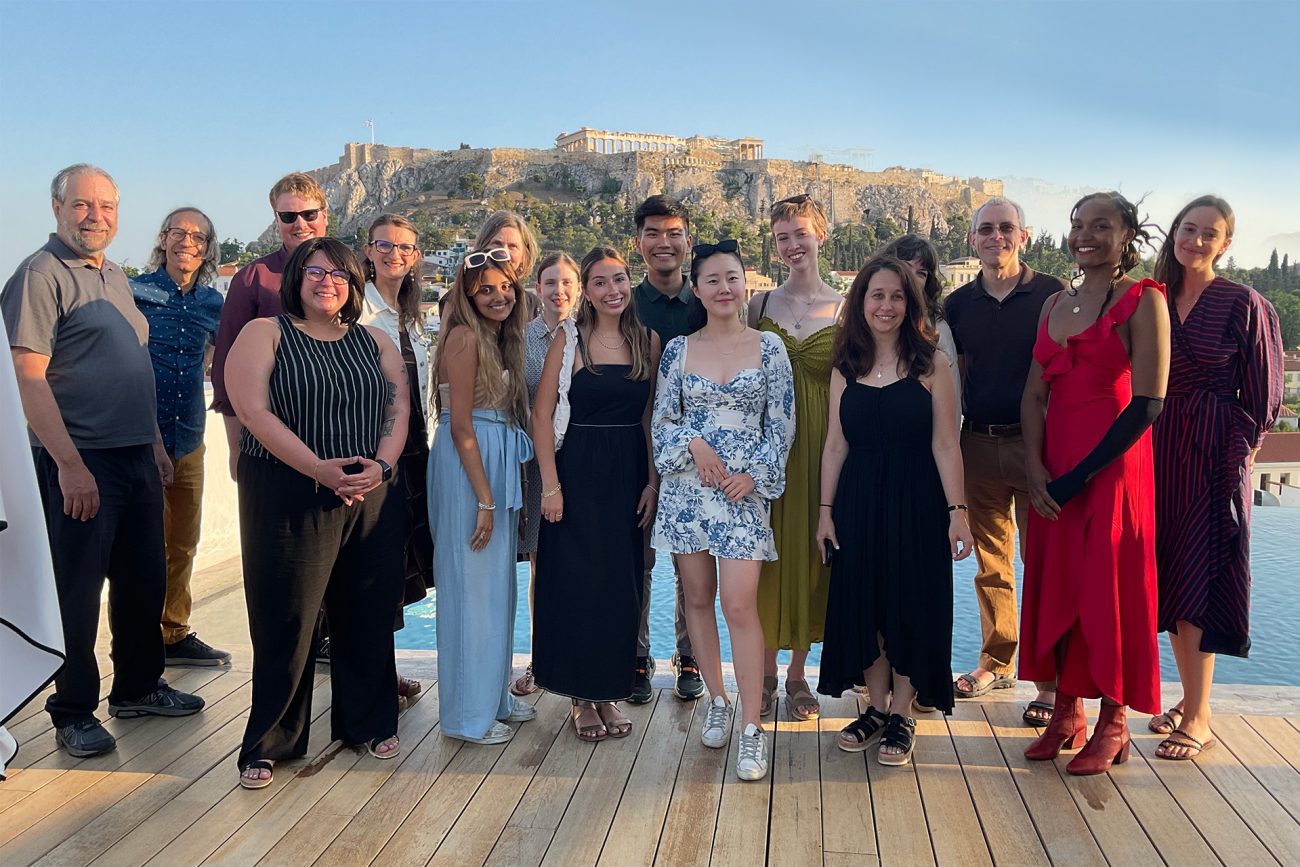
For Salvador Galvez, Nu’25, his SNF Paideia courses put him in conversation with fellow students across disciplines. He took a course called Biology and Society, which covered some controversial topics, like cloning. While his peers in majors like biology and chemistry often approached discussions by focusing on scientific ideas, Galvez thought about the application of technologies and what their effects would be on patients.
“It was important to put the ideas back into the real world,” he says. “Because of my perspective as a nursing student, I was able to add the important fact that every treatment includes a patient with emotions and feelings who doesn’t make it into the scientific literature.
“It’s easy to want to defend your position and respond in a discussion,” says Galvez. “But what I’ve learned from my Paideia courses is that if we listened more, our society would have fewer problems.”
Header image by Eric Sucar.




