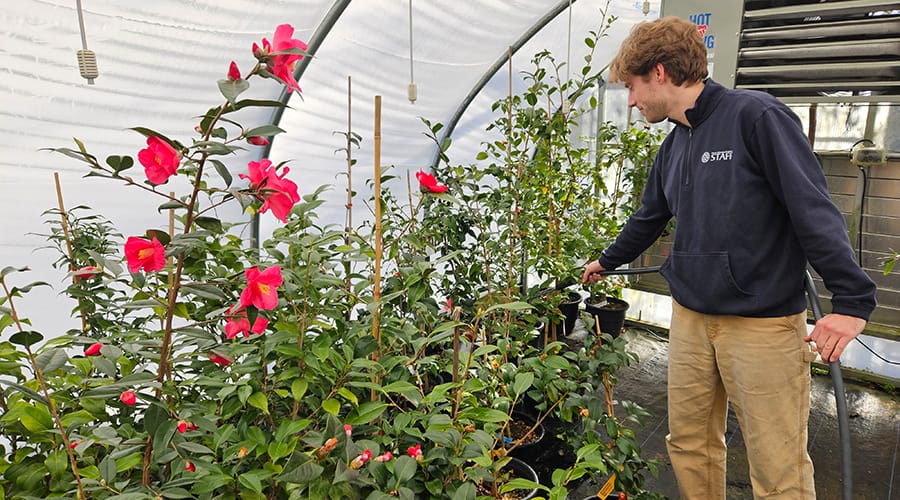
The plant kingdom is under the microscope at the Morris Arboretum.

A Garden of Knowledge
Researchers at the Morris Arboretum hope to better understand rare and endangered plants and their roles in our future
Published: March 16, 2022
Researchers are seeking a closer look at species whose roles in our ecosystem are not yet fully understood, hoping to unearth knowledge about how they interact with the world—and, in some cases, how to prevent them from disappearing altogether.
Perhaps best known among locals as a public garden, the Arboretum has served as an interdisciplinary research center since its inception. Expansion of the Arboretum’s research program is a key focus for William Cullina, F. Otto Haas, Executive Director, who was appointed in 2019. Botanical scientists at the Arboretum are seeking to augment their current work in a modernized, modular laboratory where plant-based research would be conducted—including on rare and endangered species, some of which face threats from climate change and human development.
“Every species plays an integral role in the existence of everything else,” says Dr. Timothy Block, the John J. Willaman Chair of Botany at Morris Arboretum. “Even the soil bacteria that nobody pays attention to are absolutely critical to the existence of life on the planet.”

Cryptogramma stelleri, also known as slender rockbrake, is among the endangered plants that Arboretum scientists plan to study in the modular laboratory facility.

A plant of northern affinities, slender rockbrake grows in Pennsylvania only on north-facing cliffs near waterfalls. The species is under threat due to warming temperatures.

Ripariosida hermaphrodita, also known as Virginia mallow, is globally rare and found at only a few sites in Pennsylvania, where it is listed as endangered. This plant, also a focus of Morris Arboretum scientists, is under threat due largely to development activities.

An example of a similar modular facility to that which the Arboretum hopes to employ for its research. Image courtesy Vanguard Modular.

A preliminary plan drawing of the lab’s interior space illustrates various spaces to assist with sample analysis and storage.
The modular laboratory would allow the Arboretum’s researchers, who also serve as adjunct faculty in the Department of Biology at Penn Arts & Sciences, to investigate flora that are less economically viable—and therefore less studied—than food plants or timber plants. In this area, Block says, a major gap in science still exists.
In the lab, Block and other Penn-affiliated colleagues could identify potential conservation methods for threatened plant species. That kind of work requires scientists to investigate their species’ origins, their habitats, and their similarities to other specimens—research that would be enabled and energized by this modern facility. The space would serve as an updated replacement for the current lab facility in the basement of the Arboretum’s Gates Hall, which has stood since 1893.
“If we don’t understand the relationships between species, as well as the relationships among the individual populations of rare species, we can’t do much to try to conserve them.”Timothy Block, the John J. Willaman Chair of Botany at Morris Arboretum
Plans for this modular facility are still in the germination stage. For questions about sponsoring or supporting the development of the laboratory, please contact Mira Zergani, Director of Development.