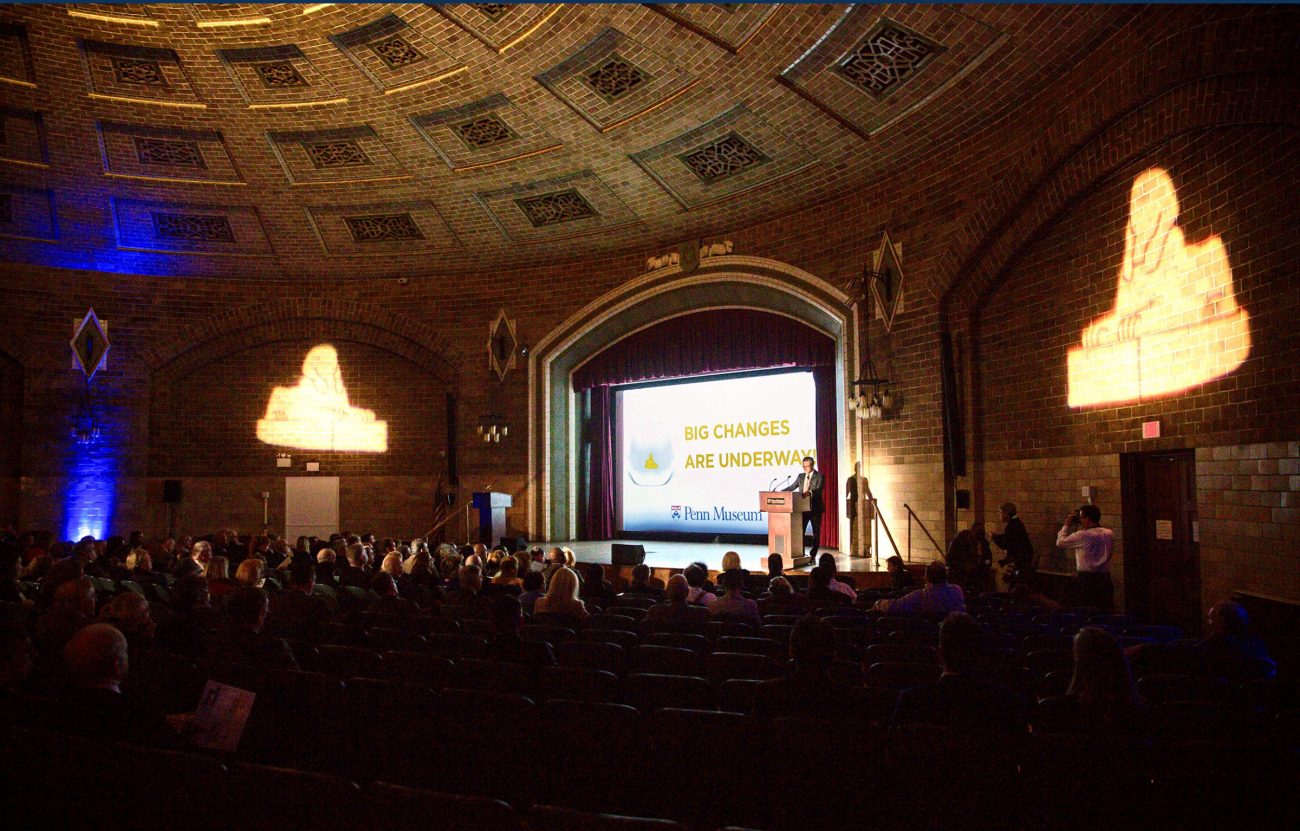
Historic auditorium poised for its future at Penn Museum
For more than 100 years, the Harrison Auditorium at the Penn Museum has provided an inspiring setting for lectures, readings, and special events. Nearly every Penn alumnus has a Harrison memory, whether it be their graduation, Hillel High Holy Day services, Penn Medicine Match Day, or a lecture by such world-renowned speakers as Margaret Thatcher, Jane Goodall or Colin Powell.
When it opened to the public in 1915, the architectural wonder wowed audiences with its dramatic domed ceiling centered by a bronze starburst. Using an ancient Roman masonry technique known as the Guastavino method, the Auditorium features a pillar-free space that allows audiences to enjoy unobstructed views from any seat in the house. At the time of its opening, Harrison’s was the largest floor dome of its kind the world, unique for supporting not only itself, but the floor of the Chinese Rotunda above it.
Today, the historic Auditorium is poised for its next chapter—a renovation that will restore it to its former glory and update it to suit the needs of the 21st century.
The reimagined space will focus on accessibility by adding accommodations for wheelchairs, a new elevator, handicapped-accessible restrooms and green room. Other improvements include air conditioning, a new lobby and coatrooms, new lighting, flooring and enhanced audio-visual equipment. In addition, the Art Deco seats installed in the 1940s will be entirely refurbished, stripped, re-painted and re-upholstered.
“Because every effort will be made to preserve its historical and architectural integrity, the auditorium will look very much the same. But the visitor experience will be totally different,” says Julian Siggers, Williams Director of the Penn Museum. “This transformation will turn one of our least accessible spaces into one of the most accessible, allowing us to welcome more visitors than ever to the Museum for lectures, K-12 programming and more.”
The Museum has invited the public to take part in this monumental effort by making a gift in support of the renovation. Donors pledging $25,000 will have their names featured on the Auditorium’s walls. For a gift of $2,500, a name and notation of up to 65 characters will be installed on an elegant metal plaque affixed to one of the Auditorium’s 618 seats. Museum Overseer and Name a Seat Campaign Co-Chair William L. Potter, WG’88, was one of the first to claim his seats, one for each member of his family including his wife, Joanne Ruckel, WG’88, and sons Daniel and Jonathan, C’18.
Others taking advantage of the seat naming opportunity are family members of the Auditorium’s namesake, Charles Custis Harrison. Harrison’s descendants have continued to honor the former Provost and Penn Museum President by supporting Penn and the Museum across many initiatives.
The renovation is a cornerstone in the Museum’s vision for the future and what they hope to accomplish through their Campaign. Their Building Transformation Campaign is an ambitious undertaking that will impact the entire building and, by extension, transform our understanding of the human experience.
The Campaign features major renovations and reinstallations of the Museum’s signature galleries; the creation of new public spaces and galleries, along with enhanced visitor amenities; an increased endowment to ensure that crucial programs will be fully staffed, with well-equipped facilities; and the expansion of the Museum’s broad range of research, teaching and public engagement programming.