
In early May, the U.S. Food and Drug Administration (FDA) expanded approval for a personalized cellular therapy developed at the University of Pennsylvania’s Abramson Cancer Center, this time for the treatment of adult patients with relapsed or refractory large B-Cell lymphoma (DLBCL)—the most common form of non-Hodgkin’s lymphoma—as well as high grade B-cell lymphoma and DLBCL arising from follicular lymphoma. This is the second approval for the nation’s first personalized cellular therapy for cancer, a chimeric antigen receptor (CAR) T-cell therapy known as Kymriah® (tisagenlecleucel, formerly CTL019).
“This is an exciting event—seeing this lifesaving therapy become available widely to a large patient population with an unmet medical need,” said Stephen J. Schuster, MD, the Robert and Margarita Louis-Dreyfus Professor in Chronic Lymphocytic Leukemia and Lymphoma Clinical Care and Research and director of the Lymphoma Program at Penn’s Abramson Cancer Center, who led clinical trials of the new approach for lymphoma. “Many lives may be saved.”
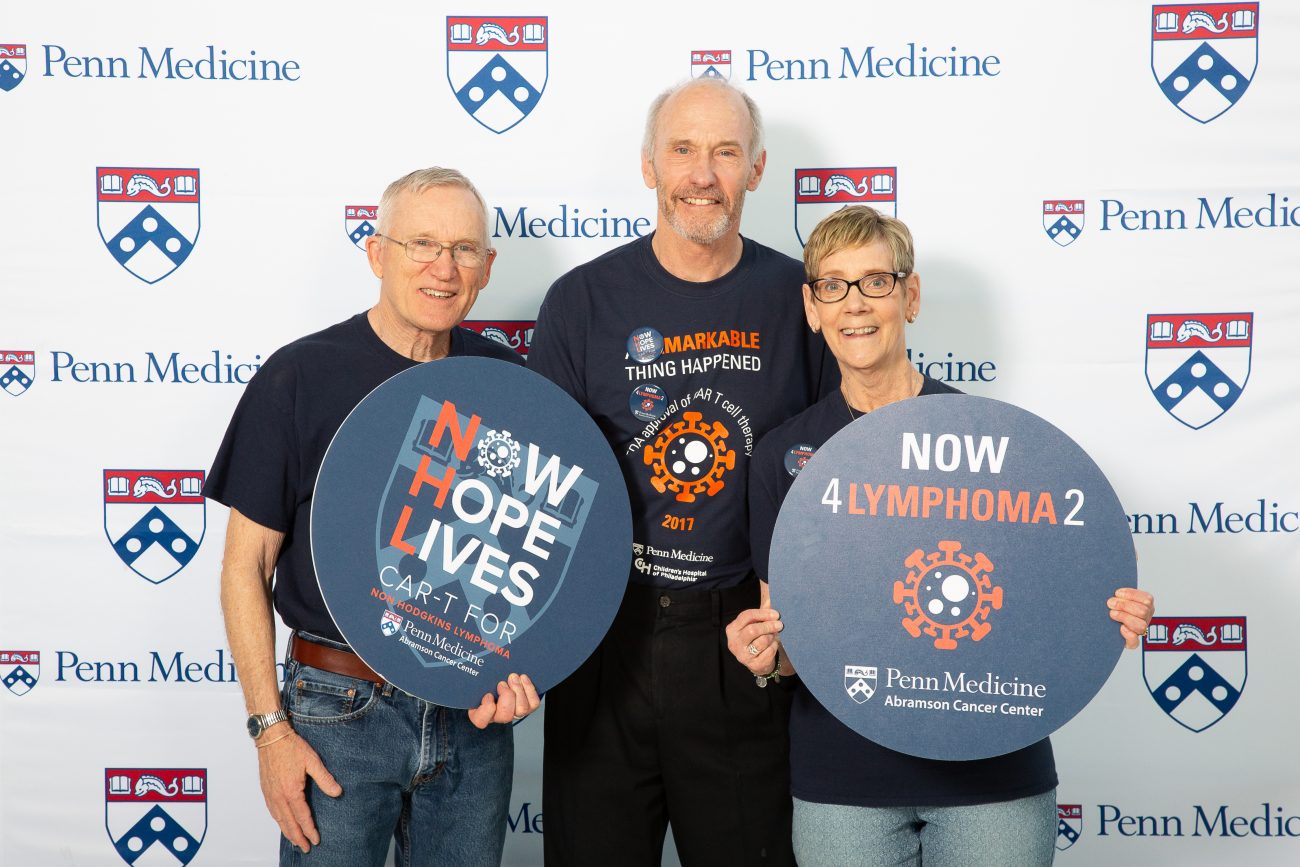
Dr. Carl June, Richard W. Vague Professor in Immunotherapy (middle),
with clinical trial participant Barbara Beaudry and her husband, John.
In August 2017, Kymriah became the first therapy based on gene transfer ever approved by the FDA when it was authorized for children and young adults with relapsed or refractory B-cell precursor acute lymphoblastic leukemia (ALL). The FDA’s action is the latest accomplishment in the alliance between Penn and Novartis, which entered into a global collaboration in 2012 to further research, develop and commercialize Kymriah and other CAR T-cell therapies for the treatment of cancers.
Investigators at Penn’s Perelman School of Medicine, who led research, development and clinical trials of CAR T therapy, called the approval a massive step with potentially life-saving implications for patients.
Penn’s pioneering research in CAR T-cell therapy has been led by Carl June, MD, the Richard W. Vague Professor in Immunotherapy in the department of Pathology and Laboratory Medicine in the Perelman School of Medicine and director of the Center for Cellular Immunotherapies in the Abramson Cancer Center.
The treatment modifies patients’ own immune T cells, which are collected and reprogrammed in a Novartis manufacturing facility to potentially seek and destroy the patients’ lymphoma cells. Once they are infused back into patients’ bodies, these newly built cells both multiply and attack, targeting cells that express a protein called CD19. Tests reveal the army of hunter cells can grow to more than 10,000 new cells for each single engineered cell patients receive—producing durable remission rates in refractory lymphoma—and can survive in the body for years.
CAR T-cell therapy trial participant Barbara Beaudry is now a survivor of non-Hodgkin’s lymphoma, becoming officially cancer-free one month after receiving her infusion of engineered cells.
“I’m so grateful to have been given this opportunity for a second chance, and even more so to be part of something that can help others through their journey in the future,” she said.
The Novartis-Penn Center for Advanced Cellular Therapeutics (CACT) opened in 2016 and hosted Vice President Joe Biden at the launch of his Cancer Moonshot initiative, cementing Penn’s role as international innovator in the development and manufacturing of personalized cellular therapies.
Additional leaders of the DLBCL research include Jakub Svoboda, MD, an assistant professor of Hematology Oncology, Daniel J Landsburg, MD, an assistant professor of Hematology Oncology, and Sunita D. Nasta, MD, FACP, an associate professor of Hematology Oncology.
Studies and trials were supported by Novartis as well as grants from the National Institutes of Health, and philanthropic support for the Lymphoma Program at the Abramson Cancer Center of the University of Pennsylvania from James and Frances Maguire and the Frances Maguire Lymphoma Research Fund, Margarita Louis-Dreyfus and Sharyn Berman and the Richard Berman Family Funds for CLL and Lymphomas.
Private philanthropy is crucial to the continued development of innovative cancer treatments. To make a gift in support of the ImmunoRevolution, click here, or contact Katie Dewees Detzel at kdewees@upenn.edu or (215) 746-1927.