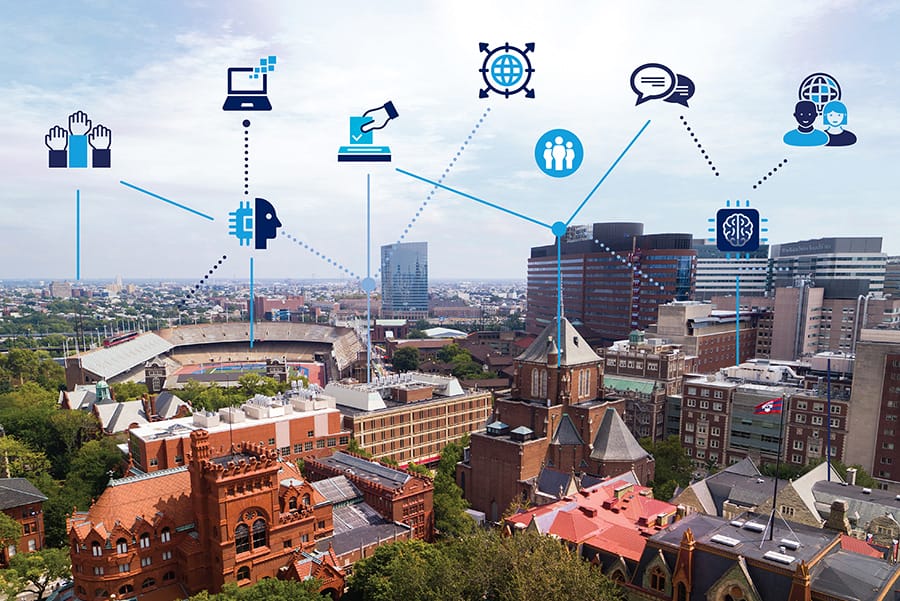
For better or worse, the human mind has the ability to fill the gaps when events occur outside of our understanding or when we face a perceived threat.

Down the Rabbit Hole
Dolores Albarracín tackles the consequences of conspiracy theories and misinformation
Published: May 3, 2022
Recently, dubious conspiracy theories regarding vaccine safety and election fraud have had dire consequences: a prolonged pandemic and a violent insurrection at the U.S. Capitol, respectively.

This tricky domain of cognition—and its impact on public health and personal behaviors—is a major focus for PIK Professor Dolores Albarracín. With joint appointments in the Annenberg School for Communication and the School of Nursing, Albarracín’s scholarship lies at the intersection of communications, public health, and social behavior. She seeks to understand the mechanisms that explain our thoughts, attitudes, and actions, with an eye on how to promote socially and personally beneficial behaviors. The time is especially ripe for these insights.
“The pandemic has increased the importance of understanding how misinformation and conspiracy theories impact the public,” says Albarracín. “As media and social networks influence thoughts and behaviors, we must remain vigilant about supporting and promoting trusted communication sources.”
The pandemic and public communication
Albarracín’s extensive work on vaccine hesitancy and rejection has become even more prominent as conspiracy theories have emerged surrounding the COVID-19 vaccines. The pandemic presented a singular opportunity to apply her expertise in communications and public health to a momentous, of-the-moment concern.
Recently, Albarracín has examined how public health communications have impacted behaviors during the pandemic, including the willingness to accept guidance. “We found that most people were not resistant to masking or stay-at-home guidelines when they were expressed as a means to a tangible goal—namely, the reopening of society and return to normality once a vaccine was available,” Albarracín says. “But when leaders fueled distrust, or planted the idea that the guidelines were tied to political motivations, then we started to see polarization emerge and the rise of risky behavior,” she says.
Although “trust the science” became a rallying cry for people hoping to debunk false claims about COVID-19, Albarracín found that no one is immune from misinformation. “There is a paradox: If you trust in science, you can be more susceptible to adopting or spreading pseudoscience,” she says. “We need to teach people how to critically engage with science, not to merely trust anything that contains a scientific reference.”
To help people gain some clarity, Albarracín worked with fellow PIK Professor Ezekiel J. Emanuel, the Diane v.S. and Robert M. Levy University Professor, to develop a roadmap for addressing COVID-19. “When it comes to communicating effectively, you need a concerted effort based on the science of communication and behavioral change, not intuitions,” says Albarracín.
Part of that concerted effort includes regular communication and building trust to ward off conspiratorial beliefs. “With an enormous, emergent problem like a pandemic, knowledge continually changes,” she says. “We need a permanent structure, with a directory of trusted sources and continual communication. Not communicating is also communicating when it leads people to believe there is nothing to worry about, or that the health system has something to hide.”
Tinfoil or truthseeking?
In her newest book, Creating Conspiracy Beliefs: How Our Thoughts are Shaped, Albarracín and colleagues present a picture of what makes a conspiracy theory alluring—and, often, difficult to remedy. “When you develop a mental model that there is a conspiracy, undoing it is not simple,” she says.
Her work confirms that conspiracy beliefs take root in fear, distrust, isolation, and powerlessness. Conspiracy believers will regularly seek outlets that corroborate their stances, and rebuttals in mainstream media or a lack of corroborating evidence can serve as confirmation of a conspiracy.
Albarracín has noted that social, historical, and psychological influences impact the propensity to adopt conspiracy beliefs. “For instance, in the African-American community, if you are aware of the horrific Tuskegee experiment, and if you cannot access regular, trustworthy health care, your faith in the health system will be diminished by that historical knowledge, your personal experiences, and your social connections,” she says. “That, in turn, might make you more willing to resist or to see conspiracy in a vaccine mandate.”
The conspiracy beliefs studied in the book have real-world consequences, such as the “Pizzagate” theory that led to an armed assault at a restaurant in Washington, D.C. However, there can be a positive side. “Some political scientists believe that conspiracy theories play a democratic function of keeping people vigilant,” Albarracín says. “It can give people who are not exposed to any information the energy to search for answers. The problem lies in what sources they find, especially with biased media that make so many disparate and, frankly, wrong opinions proliferate.”
(Mis)Information Matters
By increasing public understanding about conspiracy theories and how they affect us, Albarracín aims to protect lives, and even America’s democratic ideals.
“These issues affect us all,” Albarracín says. “When violent actors threaten our political institutions, or when public health is at stake, then small corners of the Internet can become legitimate threats. I hope that our work sheds light on these dangers, as well as ways that we can help dull the power and reach of erroneous beliefs.”