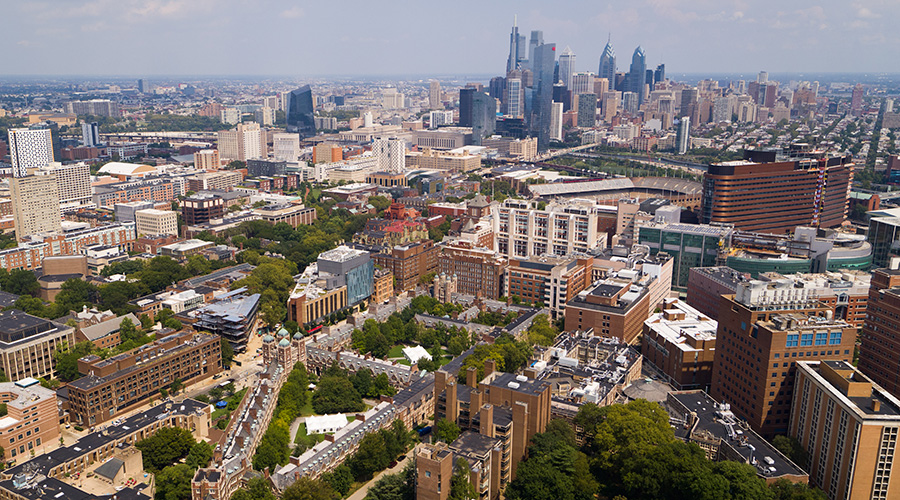
The Power of Penn Campaign will enrich our constantly evolving campus with new buildings meticulously designed with the flexibility to meet future needs. It will enable historic buildings to be reimagined and retrofitted for the 21st century and beyond. And it will create advanced facilities that will impact the treatment of disease, energy policy, the student experience and our understanding of the ancient world.
Schattner Pavilion at Penn Dental Medicine
New College House West
CAPITAL EXPANSION at Penn GSE
Pavilion at the Hospital of the University of Pennsylvania
Vagelos Laboratory for Energy Science and Technology
The Penn Museum
Wharton Academic Research Building
tangen hall
Indoor Training Facility


Advancing Premier Dentistry
Promoting and providing the highest caliber care requires the most sophisticated research and clinical facilities. As a pioneer in dental medicine, Penn Dental Medicine is at the forefront of digital dentistry, training the next generation of technologically proficient practitioners by incorporating advanced imaging, computer-assisted design and manufacturing (CAD/CAM) and 3D printing into all levels of the curriculum.
To continue to lead in a rapidly evolving field, the finish line for one major project at Penn Dental Medicine marks the starting place for the next. The Evans Building has never looked better or functioned more efficiently, thanks to extensive renovations completed as part of the Centennial Renaissance project launched on the building’s 100th anniversary. Now, Penn Dental Medicine has completed renovation of the iconic Main Clinic, renamed the Robert I. Schattner Clinic, and is constructing the Schattner Pavilion to enhance the connection of the School’s three buildings, creating a more integrated campus.

Building Shared Communities
Penn’s residential living has its roots in colonial times, when the first dormitory was constructed. Today, the signature College House system brings together undergraduates, faculty, staff and graduate students in 12 dynamic shared communities. Recognizing the benefits of this unique living-and-learning model, Penn is building New College House West to give an additional 450 sophomores, juniors and seniors access to this experience.
The new building will be constructed on a site bounded by Locust Walk and Walnut and 40th Streets. Designed by the same firm that recently completed the New College House at Hill Field, it will have common areas including study, seminar and music practice rooms, as well as green space for residents and the public.

Educating Educators in a New Space
How do you prepare educators to inspire students of all ages through hands-on learning? Provide them with a state-of-the-art space designed for brainstorming, research and learning by doing. The most innovative practices in education utilize “active” classroom spaces, and as educators of the future, students at Penn GSE must experience these approaches firsthand.
That’s why GSE plans to expand its central building at 3700 Walnut Street, merge it with nearby Stiteler Hall, and add a new two-story building, gaining nearly 25,000 additional square feet of flexible and technologically advanced learning space. This new Capital Expansion at Penn GSE will bring together the students and faculty engaged in all facets of education—teaching, counseling, leadership, policy, language diversity, learning technology, entrepreneurship and more—to shape and lead a new era in learning.

Revolutionizing the Patient Experience
The patient-centric design of the new Pavilion at the Hospital of the University of Pennsylvania incorporates the latest science on how to promote healing in a hospital setting. Patient rooms will be equipped to flex between intensive and acute care unit set-ups as the patient population and their caregiving needs change. Among its other forward-thinking design elements are comfortable areas in each patient room for family members and care-givers, and an app that helps patients better communicate with their care teams. At the heart of the new hospital’s design is an interchangeable platform to quickly and seamlessly adopt new technologies as they are invented. Built for the 21st century and beyond, the Pavilion will be where Penn provides superlative care and comfort to patients and their families for decades to come.

Stimulating Scientific Discovery
What is the optimum environment for discovery in energy science? Penn checks all the boxes: eminent researchers in a range of complementary disciplines; programs that unite faculty, undergraduates and graduate students in collaborative research; and core teaching and research facilities in close proximity. The new Vagelos Laboratory for Energy Science and Technology will augment Penn’s existing strengths by adding state-of-the-art research space that connects physical scientists and engineers. Focused primarily on energy research, this new Penn Arts and Sciences and Penn Engineering facility will have a flexible infrastructure that can be adapted as needs evolve. Located on the south side of Walnut and 32nd Streets, it will also serve as a striking new gateway to the Penn campus from Center City.

Accessing the Ancient World
The old is about to become new again. The Penn Museum—dedicated since 1887 to increasing understanding of the human experience—is embarking on a transformation of its own. The ambitious project includes new galleries to showcase the Museum’s magnificent collections, amenities to enhance the visitor experience and modernization of the historic Harrison Auditorium. A star attraction will be the new Egyptian Galleries featuring the palace of the pharaoh Merenptah, installed for the first time at full height in the soaring upper galleries of the Coxe Memorial (Egyptian) Wing. The Museum Building Transformation marks a new chapter in the history of one of the preeminent museums of human cultures and the ancient world, affirming the Museum’s role as a remarkable resource for Penn students, scholars and visitors from across the region and around the world.

Anchoring the Wharton “Neighborhood”
Some of Wharton’s research centers, programs and initiatives—currently spread across campus—will soon come together under one new roof. The planned Wharton Academic Research Building, neatly tucked into a site near the corner of 37th and Spruce Streets, has been designed as a place for Wharton community members to congregate, discover and collaborate. The design calls for mixed-use space, including versatile active learning classrooms, conference rooms and group study rooms, among other venues. Conveniently situated, it will be accessible to industry leaders participating in Executive Education programs in the Steinberg Conference Center; prospective students visiting MBA Admissions in Vance Hall; and current students traveling between classes, group meetings and faculty sessions at the new Wharton Academic Research Building, Jon M. Huntsman Hall or Steinberg Hall-Dietrich Hall.
Incubating Actionable Ideas
A light-bulb moment can happen at any hour of the day or night. That’s why the Venture Lab, led by Penn Wharton Entrepreneurship and housed in brand new Tangen Hall (not shown), will keep its doors open 18 hours a day, seven days a week throughout the academic year and summer. As the center of entrepreneurship on campus, the Venture Lab will serve as a gathering place for cross-disciplinary interaction and learning-by-doing, drawing students and faculty from across the University.
Located at 40th and Sansom Streets, Tangen Hall will include co-working spaces, a large colloquium hall and a maker space with cutting-edge tools for design innovation. The Venture Lab will be where students incubate startups as part of a community of entrepreneurs and innovators and interact with Penn alumni in diverse fields who will serve as mentors and advisors.

Inviting Athletes Indoors
Penn is about to up its game, with a premier indoor training facility tucked behind the Hollenback Center near the South Street Bridge. The building will house a six-lane, 200-meter banked track and eight-lane sprint track, along with areas dedicated to pole vaulting, jumping lanes, high jump and throwing. It will enhance Penn’s intercollegiate track training program by providing a modern venue for year-round practice. The new facility—a perennial entry on Penn Athletics’ wish list—will be a destination for recruits to visit, Penn Relays participants to warm up and Penn athletes to use all year long.