Penn’s commitment to inclusion is especially evident at the Center for Africana Studies Summer Institute. For 33 years, the week-long program in July has given incoming freshmen a taste of the college experience before their first semester begins.
“There’s a lot of work in a short time period,” says Camille Charles, the Walter H. and Leonore C. Annenberg Professor in the Social Sciences at Penn Arts & Sciences. “But we’re also mindful of creating a classroom environment that’s inviting. We want students to leave with the confidence that they can handle anything Penn throws at them.”
For students looking to build community, increase their knowledge of African and African Diaspora studies, and gain a strong sense of Penn’s academic and social culture—all before the school year begins—this is the program for you.”IAN PEEBLES, GR’22

A Solid Foundation
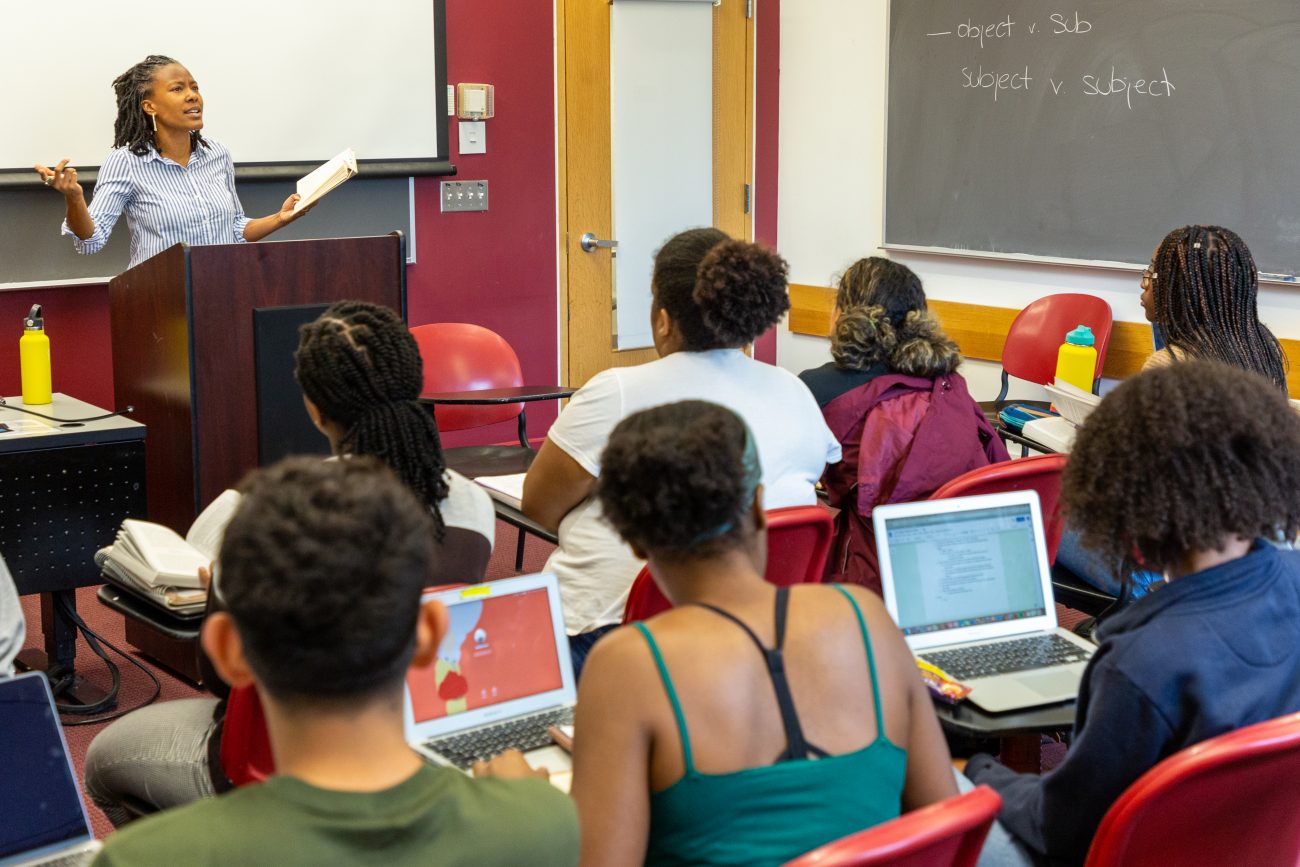
At the root of the Summer Institute is rigorous coursework in Africana Studies, similar to the crunch of a midterm week. Africana Studies spans multiple fields of study to explore how the experiences of African peoples have impacted history—the kind of cross-cutting research and scholarship that exemplifies a Penn Arts & Sciences education.
“Africana Studies is interdisciplinary, multidisciplinary, and transdisciplinary,” says Margo Crawford, Director of the Center for Africana Studies. “Our field asks the core question connecting the humanities and social sciences: What does it mean to be human?”
At the end of the week, students earn a half credit and have new academic tools at their disposal. “In our courses, students are introduced to theories and terms that are part of the academic discourse,” says Dagmawi Woubshet, the Ahuja Family Presidential Associate Professor of English. “They can apply these in their thinking and writing from the outset of their college education.”
In addition to this formal introduction to critical thinking, the Summer Institute helps students acclimate to the demands of a Penn education. “For many students, especially underrepresented minorities, Penn is unlike any experience they’ve had,” says Charles, who is also one of the Faculty Directors for Penn First Plus. “The Summer Institute is valuable preparation for when they begin classes.”
Building Bonds
As a student of color, it has immense value to me to come into a space that’s welcoming.”ELAINE RODRIGUEZ, C’23
Part of that preparation is living on their own, and community building is integral to the Summer Institute. Students live together in a high-rise College House and have group activities throughout the week. Participants are assigned to cohorts of five or six students under the mentorship of a Graduate Fellow.
These relationships continue into the school year. Summer Institute faculty serve as Pre-Major Advisors, and Graduate Fellows stay in touch with students through what can be a tumultuous first year. “I impress upon them—our students, Graduate Fellows, and faculty—that we’re like family,” says Charles. “If you see somebody struggling, you should try to help them out.”
That focus on community is one reason the Summer Institute is so well regarded by participants. “One of the reasons I chose Penn was because it has resources like this,” says Elaine Rodriguez, C’23. “This week showed me I made the right choice.”


Moving Forward
Since its first year in 1986, the Summer Institute has more than tripled its enrollment, welcoming 80 students in 2019. According to Crawford, the Center has no intention of slowing down. Through The Power of Penn Arts & Sciences Campaign, the School aims to strengthen the impactful interdisciplinary and student-centric programming at the Center for Africana Studies, including the Summer Institute.
“A strong endowment would guarantee our longevity and enable us to increase the number of students and faculty who participate,” Crawford says. “We can also add new dimensions to the program. I would love to offer workshops that bring together Penn professors and alumni mentors, across a wide range of fields and careers, who can help students shape their own academic and career paths.”
The benefits of this early exposure to college can be immense. The sooner students comfortably transition to college life, the sooner they can start making contributions to the campus community and preparing for their futures. Charles fondly recalls the story of one “late bloomer” who came to the Summer Institute and found his way with the support of the Africana Studies community.
“He was having a hard time finding his niche,” says Charles, “and a hard time speaking up in class. But he wanted to be a stand-up comedian, so he kept working at it. He found his people on campus, and he was one of the few non-Wharton Black students who studied Chinese.
“Today, he’s doing sketch comedy in China, and he’s very happy. And that makes me happy, knowing where he started and seeing where he is now.”
Learn more about the Center for Africana Studies